


- Outside View
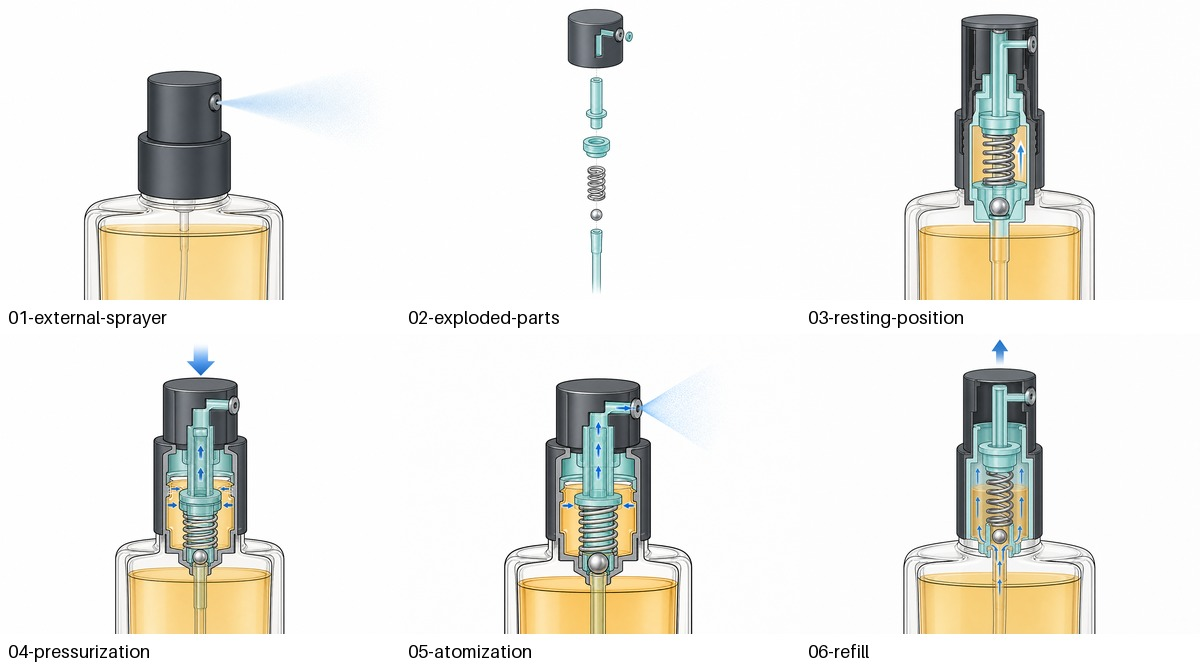
A perfume sprayer looks simple. A finger presses the actuator, and a tiny side opening releases fragrance. Inside that opening is the atomizing nozzle. Below the actuator, a dip tube reaches into the perfume. Each press moves a small quantity of liquid from the bottle to the nozzle and turns it into a fine mist. Unlike a lotion pump, the perfume actuator has no long spout, because its purpose is to project droplets into the air rather than pour liquid downward.
- Main Parts
The structure uses only a few parts: the actuator and nozzle, a hollow stem, a piston and seal, a pump chamber, one return spring, one valve ball, and the dip tube. The ball sits directly above the dip tube. Together, these parts form a sealed path that controls the perfume’s direction. The piston also keeps the moving stem sealed against the chamber wall, so pressure can build instead of escaping around it.
- Ready Position
After priming, the chamber is filled with perfume. The spring holds the piston and actuator in their raised position. At the chamber bottom, the ball rests on its seat and closes the inlet. This prevents liquid from draining back into the bottle. The sprayer is ready for the next press.
- Building Pressure
When the actuator is pressed, the stem and piston move downward while the spring is compressed. The chamber becomes smaller, so its pressure rises. This pushes the bottom ball firmly against its seat. Because the inlet is closed, perfume cannot return through the dip tube. It is forced through small side passages into the hollow stem.
- Creating Mist
Pressurized perfume travels upward through the stem and turns into the short passage inside the actuator. It reaches the small nozzle insert. The narrow opening increases the liquid speed and shapes the flow. As perfume leaves the nozzle, the stream breaks into tiny droplets. They spread outward as the soft, even mist expected from a perfume atomizer.
- Refill
When the finger is lifted, the spring pushes the piston and actuator upward. The growing chamber creates lower pressure. This suction lifts the bottom ball slightly. Perfume rises through the dip tube, passes around the centered ball, and refills the chamber. When pressures balance, the ball returns to its seat. The inlet closes, completing one pumping cycle. A new sprayer may need several presses to remove air and fill the chamber.
Pingback: Perfume sprayer pumps: types, mechanisms, and common problems | DHgate Lifestyle Guide